Thursday, March 11, 2010

Prison Reform - Alex E


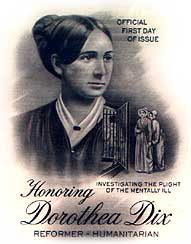
One day in 1841 a woman named Dorothea Dix agreed to teach Sunday school at a local prison. What she saw that day changed her life forever.

Dix saw that the prisoners were treated horribly. They were bound in chains and locked in cages. Children that committed only minor thefts were locked up with adults! She was outraged when she saw this and wondered if prisoners everywhere were treated like this. She also visited many debtors and they most were locked up for less than twenty dollars!
What shocked Dorothea most was the way that they treated the mentally ill. They were locked up in dirty over crowded prisons and were whipped if they misbehaved.
All of this lead to Dix wanting change. She gathered information for years and prepared a report for the Massachusetts state Legislature. They were shocked by Dix’s report and decided to make public asylums for the mentally ill. Inspired by her success she decided to go to other states and help the mentally ill there too.

Equal Rights for Women - Taylor


The problem with women’s rights was that many women were treated horribly in the mid 19th century. Men thought women only cleaned house and cooked for their families but women wanted to do the same things as men. Women couldn’t speak in a meeting or vote and many young girls could not attend school only boys were allowed to attend.
People that changed women rights are Lucretia Mott and Elizabeth Cady Stanton. They both meet at an anti-slavery conference in 1840. They both were outraged to see how women were treated so badly. Mott and Stanton decided to hold a women’s convention in Seneca Falls. Both men and women attended the event even African Americans came to the convention.
The Seneca Falls convention helped create an organized campaign for women’s rights. Women finally got to be treated equal and many women from all States got to control payments and even a woman got to start her own hospital. According to www.legacy98.org women and men are finally equal because of hard work and strength of many women who were treated poorly.

Prisons - TJ


Many people were in these prisons because they were in debt. Other people were in the prisons because they were mentally ill. Some were in cages, cellars, stalls. Most were beaten, some were naked.

Dorothea Dix was a woman that went to these prisons to look how these people were treated. After she saw the conditions, she wanted to change the prison system.

By the time she died the states no longer put debtors in prisons. And good mental hospitals were built for the mentally insane.


I think this movement was very successful. According to The National Association of Psychiatric Health Systems (http://www.naphs.org/) there are “more than 600 specialty psychiatric hospitals, general hospital psychiatric and addiction treatment units and behavioral healthcare divisions, residential treatment facilities, youth services organizations, and extensive outpatient networks.”

Tuesday, March 9, 2010

Prison Reform - Alex S


Dorothea Dix prison reform efforts were a success. She was very mad about the way the mentally ill were treated. Also how kids were in the same cells as the adults. Dix was disappointed how the mentally ill were treated just because they weren’t like everyone else. They were beat and lived in dirty prison cells. Also how that when in debtor’s prison that you can’t work to pay off the debt.

Dorothea after a while was just fed up with it so she went to the Massachusetts legislator with a detailed report. She was shocked to see that the lawmakers voted to create public asylums for the ill.

Was a success because there are still asylums for the ill today and children aren’t in the same prisons as adults and don’t share the same cells as adults. According to the Britannica encyclopedia “she even inspired 15 other states and Canada to make asylums for the mentally ill.”

Equal Rights for Women - Ceirra


The problem is that women do not get the same rights as men. In the mid 19th century women were treated very badly. However woman wanted to do the same as men, but men believed that women could only clean and cook. Also girls could not attend school, only boys could.
There were many reformers that were involved in this situation. One was Elizabeth Cady Stanton. When she was 25 years old, she had just gotten married. Elizabeth had never spoken in public. When she was younger she realized that women were not treated fairly. When she went to high school she attended Troy Female Seminary. While she was there she studied history, about women’s rights. When she met Lucretia Mott, in London she agreed that some thing needed to be done, for women’s rights.
The women who wanted to change went to the Seneca Falls to create the Declaration of Sentiments. Slowly the women got there rights and were treated the same as men were. The equal rights for women was very successful to women, because they can do the same as men and now they get treated the same.

I think that Elizabeth Cady Stanton’s reform efforts were very successful. According to the U.S. Census Bureau (http://quickfacts.census.gov/qfd/states/00000.html) in 2002 28.2% of business firms were owned by women.

Abolition - Michelle


The abolition movement was the fight against slavery. Slavery was a terrible thing and slaves were treated horribly. Something defiantly needed to change and quick. This was defiantly a struggle but it paid off in the end. This all started in the 1830’s, when people started asking how can the home of the FREE still allow slavery? In 1835 a poster appeared on walls throughout Washington DC, half of the poster showed a picture of our founding fathers reading the declaration of Independence and it said the Land of the Free.
Some Americans had opposed slavery even back during the revolutionary war times. Quakers in 1776 stopped owning slaves and in 1792 every state down to Virginia had anti-slavery societies. Even though there was no slavery in the North they still supported the Southern Slavery. There were blacks and whites that wanted slavery to end, but not everyone agreed on how to end it. Radicals encouraged slaves to run away, others wanted to give farmers time to learn how to do things without end, and others wanted a peaceful way to end slavery immediately. When Fredrick Douglass spoke (an escaped slave) spoke out to a group of people, they cried when they heard how children were treated and laughed when he told them that ministers said that they should love slavery. Douglass soon became a leader in this movement and he started a newspaper called the North Star, saying that “Right is of no sex- Truth is of no color”.
Many women were inspired by the religious movements and became involved in the fight against slavery. When a young woman by the last name of Grimke spoke against slavery, a group of anti-abolitionists threw stones at her, but she continued to speak so they burned the building. The Grimke sisters lead the way for women to speak in public. Some abolitionists were very religious slaves and spoke at all sorts of important meetings. Abolitionists were a minority even in the North but what they spoke and how they acted despite everything that happened to them helped change the attitudes of some Northerners.
This movement was defiantly successful! According to the Census Bureau in 2000 there are 24,903,412 African Americans in America and they are all free.
It also helped pave the way for the next great reform movement, women’s rights.

The Rights and Treatment of Women


By Katie

Today, women have the same rights as men. But, it wasn’t always that way. In the 1800’s, women did not have many of the same rights as men. Sure they could speak out against slavery and the way slaves were treated, but their husbands could discipline them whenever they wanted. Women could try to convince lawmakers to outlaw slavery, but women could not vote or hold office. Working to raise money for the movement was perfectly acceptable for women, yet their husbands and fathers controlled their money and property.
Elizabeth Cady Stanton and Lucretia Mott would not take this. They met at the World Anti-Slavery Convention in London, in 1840. When they got there, they were furious to find that women could not speak at the meeting and they had to sit in the balcony, behind a curtain. When they met, the both agreed that something must be done to stop the injustice and suffering of women. When Lucy Stone graduated from Oberlin College, the faculty asked her to write a speech. The problem with this was a man would have to give the speech because the school didn’t allow women to speak in public.
After she graduated, she spoke out about women’s rights. She refused to pay property taxes because women could not vote. Stone’s sister-in-law, Elizabeth Blackwell was a very smart woman who wanted to be a doctor. A helpful doctor even tutored her. Because she was a woman, she was rejected by 29 medical schools before one finally accepted her. Even though she was the country’s first female doctor and graduated at the top of her class, no hospitals or doctors would agree to work with her.
Elizabeth Cady Stanton and Lucretia Mott decided to hold a convention in Seneca Falls, New York for women’s rights. The convention’s organizers modeled the Declaration of Sentiments, which was their proposal for women’s rights, after the Declaration of Independence. The Declaration on Sentiments listed men’s acts of tyranny over women. While at the convention, Stanton proposed that women demand the right to vote. Many people thought this was too big a step, except for Frederick Douglass. He agreed that women should have the right to vote, because he thought black men should have the right to vote. And if black men had the right to vote, then black women should have the right to vote also, which meant all women should have the right to vote. Douglass’s speech inspired the convention voted narrowly to approve this last resolution. Susan B Anthony gave the speeches that Elizabeth Cady Stanton wrote. Women gained many rights because of what went on at this convention.
I think this was a successful reform because women now have many more rights than they had in the early 1800s. According to http://www.history.com/topics/the-fight-for-womens-suffrage the 19th Amendment was made to the Constitution on August 26, 1920. All American women declared they deserve all the rights and responsibilities of citizenship, like men.